Abstract
This research presents the legal perspective of blasphemy and it focusses on the blasphemy laws in different countries including five Muslim countries (Saudi Arabia, Iran, Egypt, Pakistan and Malaysia) three Non-Muslim countries (Denmark, England and Norway) and three secular states (Turkey, India and Indonesia). Results of the research demonstrate that blasphemy laws are present in all five selected Muslim countries. In case of Non-Muslim countries, laws have been demolished in England and Norway but present in Denmark whereas, in case of secular states, these laws are present in all three countries. However, in India, blasphemy laws are more known by the name of ‘laws for hate speech’. Moreover, interviews from a lawyer and religious representatives explain that punishments for blasphemy should be given according to a certain procedure and states should play an active role in protecting the religious sentiments of their citizens.
Key Words
Blasphemy, Muslim, Secular and Non-Muslim States
Introduction
Background of the Study
According to the article 19 of “The Universal Declaration of Human Rights”, freedom of speech or freedom of expression is defined as, "Everyone has the right to freedom of opinion and expression; this right includes freedom to hold opinions without interference and to seek, receive and impart information and ideas through any media and regardless of frontiers" (Tiburon, 2001). But, when it comes to copyright violation, public security, hatred speech, pornography and violence mainly, freedom of speech is restricted by the governments due to certain ethical limitations. However, limitations on the freedom of speech vary from region to region because of the cultural influence and opinions of the third party in any state. Apart from suppression, copyright violation, public security, hatred speech, pornography and e.tc, there is another important factor which questions the existence of free speech and that is ‘Religion.’
Co-existence of free speech and religion is a debatable since many centuries because of the involvement of faith, beliefs and emotions with religion. In modern times, ‘reverence’ is the word with is used to explain the relationship of religion and emotions. On the discussion of reverence and religion, Abraham Maslow says that "Religionizing only one part of life secularizes the rest of it" (Keyes, 1983). According to Maslow, religion makes us reverence by the help of rituals but its familiarity sometimes denies awed feelings. It is observed that combination of rituals, beliefs, emotions, culture and faith in a religion gives birth to another phenomenon which is known as, ‘Blasphemy.’ Several dimensions are associated with this term but by definition it is explained as, “An insulting act which lacks of reverence for God or claiming the attributes of divinity or any offence action that disrespect God and sacred things is known as blasphemy” (Merriam-webster.com, 2019).
Practice of Blasphemy Laws in different Regions
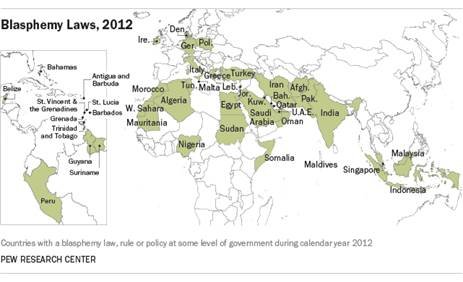
In some religions, blasphemy is completely a crime and strict punishments are given to the culprit. But on the other hand, it can only be said that blasphemy laws depend more upon the nature of government and influence of religion in a particular country. It can be noticed that anti-blasphemy laws are mostly common and strict in Muslim countries such as Middle East, Pakistan and North Africa but these laws are also harsh in some Western European countries which include Italy, Denmark and Germany most importantly (David, 2015). According to the report of Pew Research Centre as of 2012, 22% of the countries in the world have anti-blasphemy laws and 11% have policies for the punishment of apostasy which includes fine and death sentence even (Theodorou, 2014)
Figure 1
Blasphemy Laws in different countries, 2012

Strict blasphemy laws can be noticed mostly in North Africa and the Middle East. In these two regions, 70% of the countries ban blasphemy and 60% countries ban apostasy. While blasphemy laws also exist in 16% of European countries and 31% of the USA (Theodorou, 2014). When it comes to Asia, especially Pakistan, it can be noticed that here, blasphemy laws originated during the colonial past. British colonizers introduced penalties against disrespecting
religions which influenced the constitution later on after the independence of the country in 1947 (Theodorou, 2014).
Research Questions
Research questions of this particular study are as follows;
? What are the different blasphemy laws practiced in different countries of the world?
? What are the blasphemy laws in Muslim countries? (case study: Saudi Arabia, Iran, Egypt, Pakistan and Malaysia)
? What different sects in Islam say about blasphemy? Does the punishment of blasphemy equal for Muslim and non-Muslim?
? What are the blasphemy laws in those countries which follow Church as their state religion? (Case Study: Denmark, England, Norway)
? What are the blasphemy laws in those countries who claim their selves as secular states but have Muslim population in the majority? (Case Study: Turkey, Indonesia, India)
? What are the major cases of blasphemy in the selected countries?
Objectives of the Study
This research aims at developing basic understanding about the concept, ‘blasphemy’ and knowing its legal perspective in different countries. Objectives of this study are as follows;
? To study the practice of blasphemy laws in different countries of the world.
? To study blasphemy from the perspective of different sects in Islam.
? To study the major cases of blasphemy in different countries.
Literature Review
Freedom of Expression
Peter Jones (1980) focused on the freedom of expression which has to be emphasized by Liberal school of thought. He described which limits defined by liberals and which parameters are identified for individuals. The contradictory issue is the excessiveness of expressions which are found to offend people. He also examines which words and expressions clearly consider an offence like blasphemy (Jones, 1980). Tariq Modood (1993) researched about religious identity and racial equality of Muslim in Britain. He explains that before 1989 Muslims of Britain did not express their views among states because of minority conditions. After Rushide Affairs 1989 Muslims had a great opportunity to express and participate in state affairs. The policy formed by the British government and researchers found Muslims were more likely to participate in voluntary aid in schools and become stronger in political affairs. The two policies demanded that Muslims interventions in the education sector and distinctive policy of race relations in legislative area; found irregularities. He talked about the protection matters for Muslims and other community to secure in different departments like Blasphemy, hatred and discrimination in employment field. Muslims were conscious about radical school and this issue was included in the Commission for Radical Equality and debated on the Second Review of the Race Relation Act 1976. The Muslims found the ways how to pursue legally and what remedies formulated in this act for Muslims in Race relations and other confusing matters (Modood, 1993).
Blasphemy in Judaism
Talking about the blasphemy in Judaism, Rabbi Jacobs (2006) writes that blasphemy is explained as ‘Birkat hashem’ in Hebrew which means, “blessing [euphemism for cursing] the Name [of God].” Whereas, the person who is blasphemer, known as Megaddef in Judaism. Furthermore in Mishnah (Sanhedrin 7: 5), it is noticed that punishment of the blasphemer is stoning and the word of Tetragrammaton is used for this act (Jacobs, 2006). Piero Stefani analyzes blasphemy in Judaism from three different dimensions which includes the relationship of Biblical Foundations and Intra-Jewish standards, investigations and blasphemous attitude of Jews towards other religions specifically Christianity.
Piero Stefani (2014) explains that there are basically two verses mentioned in The Book of Divine Commandments which tells about the blasphemy and its punishment in Judaism. In Leviticus 24:16, it is explained that, “The prohibition of saying the Great Name is the issue that is called “cursing.” The punishment is being stoned to death.” And in Exodus 22:27, it is explained that, “You shall not revile God, nor curse a prince of your people” (Stefani, 2014). First verse of Leviticus explains that blasphemers must be stoned to death. But to decide that at what place this punishment should be given, one must consult the other verse (Exodus 22:27) where it is mentioned that prohibition is obvious. The entire passage in Exodus refers to “Elohim lo’ taqqel” which means, “Do not curse God.” On the other hand, Leviticus indicates cursing in the name of YHWH. Both these references explain that according to rabbinical law, the death sentence is for the Jews who publicly insult the name of God (Stefani, 2014).
With reference to punishment of non-Jew, Maimonides refers to the seven laws revealed to Noah by God. These seven laws do not include the blessings of holy name but blasphemy is included. When it comes to punishment for non-Jew, verses of Leviticus 10 to 16 explains that Moses gave punishment of death to an Egyptian which shows that punishment is same for both Jews and non-Jews. However, insulting Torah, Moses and prophet is not punishable by death penalty according to Judaism and in current point in time; Jews do not follow these rules (Jacobs, 2006).
Blasphemy in Christianity
Another major divine religion in the world is Christianity and blasphemy is also discussed in the Holy Bible. In Deuteronomy 13:7 to 12, it is revealed,
“If your own full brother, or your son or daughter, or your beloved wife, or you intimate friend, entices you secretly to serve other gods, whom you and your fathers have not known, gods of any other nations, near at hand or far away, from one end of the earth to the other: do not yield to him or listen to him, nor look with pity upon him, to spare or shield him, but kill him” (Islamicboard.com, 2006).
From the above mentioned verses, it is clear that serving other Gods is not tolerated in Christianity even. Like these verses, there are many other verses in the Bible which explain that blasphemy is tolerable in Christianity even. In Psalms 75:18, Romans 2:24, blasphemy is explained as speaking evil of God whereas, in Acts 18:6 and Jude 1:9, it refers as Abuse. Verse of Matthew 12:31 explains that blasphemy against the Holy Spirit is unforgiven. It is explained that, "Every sin and blasphemy shall be forgiven unto men; but the blasphemy against the Spirit shall not be forgiven” (Biblehub.com, 2019). Old Testament also explains that blasphemy in the name of God is punishable by Death (Biblehub.com, 2019).
But when the practices of these teachings are studied in the current era, it can be noticed that these teachings are not mixed with the will of free speech. These laws were commonly practiced in history or even during the time of Christ but now, these punishments are rejected because of the influence of freedom of speech. It can be noticed that there was a time when Christ could not be shown in any film but when the movement of liberalization was started in the 1960s, a Spanish actor was portrayed as Jesus in Spain in 1964 (Crabtree, 2012).
Blasphemy in Islam
In Islam, blasphemy refers to denying or speaking evil to God, Prophet Muhammad (P.B.U.H) and sacred things. Quran does not mention any specific worldly punishment for blasphemy however; Sunnah (hadith) suggests different punishments for this act which include death penalty even. Punishments for blasphemy in different Fiqhs are different depending upon the nature of the blasphemy act. Punishments include fines, hanging, imprisonment and e.tc. There are a number of verses mentioned in the Quran and there are many Hadith in which blasphemy is explained. When it comes to analyzing the act of Blasphemy in the light of Quran in chapter 33, verses 57 to 61, Allah says,
? “Those who annoy Allah and His Messenger - Allah has cursed them in this World and in the Hereafter, and has prepared for them a humiliating Punishment. Truly, if the Hypocrites, and those in whose hearts is a disease, and those who stir up sedition in the City, desist not, We shall certainly stir thee up against them: Then will they not be able to stay in it as thy neighbors for any length of time: They shall have a curse on them: whenever they are found, they shall be seized and slain (without mercy).”
? In Quran, 4:140, Allah says, "When ye hear the signs of Allah held in defiance and ridicule, ye are not to sit with them unless they turn to a different theme."
? In Quran, chapter 9 verse no. 47, Allah says, ". . . But they uttered blasphemy . . . if they repent, it will be best for them, but if they turn back, Allah will punish them."
From these above-mentioned verses, it can be noticed that Allah did not order death punishment for the blasphemer. Allah mentioned not to sit with them and preferred to give them a chance to change themselves initially as mentioned in Quran 9:47 and 4:140 (Ahmad, 1998). But on the other hand, some Islamic scholars refer to the other verses of Quran which are strict towards blasphemy. In Al-Maidah 5:33, Allah says, “The punishment of those who wage war against Allah and His Messenger, and strive with might for mischief through the land is: execution, or crucifixion, or the cutting off of hands and feet from opposite sides, or exile from the land: that is their disgrace in this world, and a heavy punishment is theirs in the Hereafter”. Moreover, verse no.1 of chapter 111, refers to the end of Abu-Lahab. Abu Lahab was the uncle of Prophet Muhammad (P.B.U.H) but he was among his major enemies. This particular verse recalls the incident when Allah said Prophet Muhammad (P.B.U.H) to gather his relatives for delivering the message of Allah and Abu-Lahab refused to follow the message of Allah (Gilani, 2010).
Hadith or Prophet Muhammad’s Sunnah is the other way of gathering information in Islam. With reference to the blasphemy, Sahih Bukhari and Sahih Muslim both confirms the incident of Ka’b b. Ashraf who said negative and evil remarks towards Allah and Muhammad bin Maslama asked permission from Prophet Muhammad (P.B.U.H) to kill him. Prophet affirmed it and Muhammad bin Maslama killed that person (Sunnah.com, 2015). Prophet Muhammad (P.B.U.H) was given the title of Rahmatul Lil Alameen (Mercy to the world). It shows that he was not only the prophet of Muslims or the leader of Muslims but he is actually the leader of all mankind. His teachings are not limited to the Muslims only because Allah sent him in the world for all. Peter Jacob and Aftab Alexander write in their book that there are many incidents in the life of Prophet Muhammad (P.B.U.H) where it can be seen that he forgave those who insulted him. An incident of old lady is very famous in the Islamic history who threw garbage on Prophet Muhammad (P.B.U.H) but he forgave her (Jacob & Alexander, 1995).
Research Methodology
For this research study, two types of research methodologies have been used. One is descriptive research methodology and the other is in-depth interviews. This is basically an inductive research therefore; narrative research methodology will help in knowing the details on every research question. By using this particular method, researchers can easily explain the different themes. In order to make the research more credible, in-depth interviews are also conducted. Keeping in view the need of the research, interviews are conducted from a lawyer and some religious representatives. Both telephonic and face-to face interview techniques are used in case of in-depth interviews.
Data Analysis and Findings
Blasphemy laws in Muslim Countries
(Saudi Arabia, Iran, Egypt, Pakistan
and Malaysia)
Blasphemy in the light of different
Fiqhs of Islam
Talking
about the punishments of blasphemers, different Fiqhs have different opinions.
In Islam, major fiqhs are Hanafi, Maliki, Hanbali, Shafi’i and Ja’fari (Shia).
Punishments vary depending upon the fiqh. A brief description is as follows;
Table 1. Punishment
of blasphemy in different Fiqhs
|
Fiqh |
Opinions on the Punishment of Blasphemy |
|
Hanafi |
?
Blasphemy is a synonym of
apostasy. ?
Accepts the repentance of this act
first. In case of refusal to repent, punishment is death for Muslim man and
for Muslim woman, it must be imprisonment with beating till she returns to
Islam. ?
In case of non-Muslim, tazir is a
punishment which can be death, caning or arrest) |
|
Maliki |
?
Blasphemy is an offense and it is
more severe than apostasy. ?
For Muslim man, it will be death.
Penance is not accepted. For Muslim woman, arrest is the punishment and she
will in the custody until she turns back to Islam. ?
For non-Muslim, punishment is
there and before this, he/she must be invited to convert to Islam. |
|
Hanbali |
?
Blasphemy is more severe than
apostasy. ?
Death penalty is for both Muslim
men and women. Retention is not acceptable.
|
|
Shafi’I |
?
Blasphemy is different from
apostasy. ?
Repentance is acceptable. If a
blasphemer does not do so then the ultimate punishment is death. |
|
Ja’fari (Shia) |
?
Blasphemy is against Islam, its
prophets and imams. ?
For Muslim, punishment is death. ?
For non-Muslim, he/she should be
invited towards Islam and give a chance to convert in Islam. Otherwise
killed. |
Blasphemy Laws in Muslim Countries
Blasphemy laws in different Muslim countries are as following.
Saudi Arabia
In Saudi Arabia, blasphemy laws are influenced by the Hanbali School mostly with a little bit combination of Jafari, royal codes and fatwas by the Council of Senior Religious Scholars. According to the law of the kingdom, blasphemy is treated as a case of apostasy. In Saudi, Sunni Islam is practiced which is known as Wahhabism. Talking about blasphemy, insulting Prophet Muhammad and Quran is also taken as blasphemy. Punishment of blasphemy includes prison, fine, lashing and death depending upon the nature of the case. In Saudi, it can be seen that Wahhabism is practiced therefore many Ismaili Muslims and Shia Muslims were arrested under this law. Blasphemy is punishable by death in Saudi Arabia, but common practice is imprisonment there.
Malaysia
Malaysian school of jurisdiction is practiced in Malaysia and according to them blasphemy should be controlled and therefore both Muslims and non-Muslims guided about morals and principals of Sunni Islam. Even in that case, if someone is accused of blasphemy then punishment is given according to the legislature. According to the Malaysian penal code (article 295), “Whoever destroys, damages or defiles any place of worship, or any object held sacred by any class of persons, with the intention of thereby insulting the religion of any class of persons, or with the knowledge that any class of persons is likely to consider such destruction, damage or defilement as an insult to their religion, shall be punished with imprisonment for a term which may extend to two years or with fine or with both” (Vesterinen, 2013). Furthermore, in their article 298, hurting anyone’s religious feelings is punishable by imprisonment and fine or both. This article elaborates that speaking or writing anything which hurts the other’s dignity, creates hurdles in maintaining harmony is also punishable by fine and imprisonment. As per the article 3(1) of Malaysia, “Islam is the religion of the Federation; but other religions may be practiced in peace and harmony in any part of the Federation” (Vesterinen, 2013). According to the judicial system of Malaysia, cases of blasphemy pass through two types of courts and matters of blasphemy are dealt with by sharia courts.
Egypt
Egyptian schools or Egyptian laws are very strict in terms of blasphemy. Government of Egypt has been even criticized for such severe restrictions on freedom of speech but still Egypt’s penal code is strict towards blasphemy and insult of the religion. Limitations are also applicable on the work of journalists, authors and publishers. Egypt’s blasphemy law refers to its article 98f. An Islamic principle, hisba is also applicable in Egypt according to which a Muslim can come to the courts with a case against the other Muslim for violating the Islam and its principles. Punishment of blasphemy includes mistreatment, fine and death penalty. Abdullah al-Mishadd, head of the fatwa council at Al-Azhar University issued a fatwa in 1978 according to which, “This man has committed apostasy; he must be given a chance to repent and if he does not then he must be killed according to Sharia. As far as his children are concerned, as long as they are children they are considered Muslim, but after they reach the age of puberty, then if they remain with Islam they are Muslim, but if they leave Islam and they do not repent they must be killed…” (Former Muslims United, 2010).
In deciding the punishments Al-Azhar University of Egypt has been playing an active role since 1985 and the government consults with the Islamic research council at Al-Azhar for religious matters. IRC played its role in giving punishments to many writers and authors for their blasphemous writings (The Impact of Blasphemy Laws on Human Rights, 2011). Recently in 2015, on the issue of Charlie Hebdo and republishing of the cartoons, Al-Aznar’s Imam, Ahmed El-Tayib said Muslims to ignore the Charlie Hebdo’s “nasty frivolity” and president of the country also ordered to ban those foreign publications that insult the religion (Gundy, 2015).
Iran
Iran follows the principle of Twelver Jaafari School as majority of the population in the country is Shia Muslim. Laws of blasphemy in Iran apply on criticizing the Islam, insulting it and publishing any offensive material which is against the Islamic teachings. Punishment of this act includes detention, torture and death penalty. In 1989, when Salman Rushdie wrote his book The Satanic Verses, Ayatollah Ruhollah Khomeini issued a fatwa which states that,
“…… author of The Satanic Verses, a text written, edited, and published against Islam, the Prophet of Islam, and the Koran, along with all the editors and publishers aware of its contents, are condemned to death….. so that no one will dare insult the sacred beliefs of Muslims henceforth. And whoever is killed in this cause will be a martyr, God willing” (Iranhrdc.org, 2012).
Other Shia representatives like, Sheikh al-Tusi says that, “Whoever insults the Messenger of Allah, or any of the Imams, his blood has become liable to shed, and it is lawful for whoever hears that to kill him, so long as he does not fear through his killing for himself or others” (Iranhrdc.org, 2012).
Pakistan
Pakistan came into being in 1947, but a matter of fact is that its history is very old because, before 1947, it was known as the Subcontinent. Before the blasphemy incident of Raj Pal, only one case of blasphemy occurred during the regime of Mughal King Akbar. A Hindu insulted Prophet Muhammad (P.B.U.H) and Muslim religious representative killed him by issuing a fatwa against him. When Akbar came to know this act, he ordered to arrest that religious representative first and then punish him with death penalty because according to Akbar, the only state has the right to give punishment and lead the proceedings of the court.
In sub-continent, an incident of Ghazi-Ilm Din Shaheed got so much appreciation because he killed a person named as Raj Pal for writing a book by the name of “Rangeela Rasool.” He also gave death penalty despite the efforts of Muhammad Ali Jinnah by the Indian Penal Court for going against the law of the state. It is the fact that before partition, Muslims and non-Muslims were living with peace in the sub-continent or at least they respected each other’s religious feelings. But in 1949, it can be seen that due to the influence of Islamic political parties, Qarardad-e-Maqasad was passed in which citizens of Pakistan were distributed into two, Muslims and Non-Muslims. In 1953, it can also be observed that movements against Qadyanis were also started in the country and due to which it is clearly mentioned in the constitution of 1973 that Qadyanis are not Muslims (Jacob & Alexander, 1995, pp.18).
In 1977, it can be also observed that same people started to protest against Zulfiqar Ali Bhutto, who made the constitution of 1973, and slogans of “Nafaz-e-Nizam-e-Mustafa” were raised. When general Zia took over Bhutto, he used this slogan for almost 11 years and promoted religious political parties. Besides many other amendments, Zia approved a law against blasphemy and initially he said that this law only implies on Qadyanis, but matter of the fact is that this law is misused in Pakistan since that time and Muslims, Christians, Hindus, all are becoming the victim of it (Jacob & Alexander, 1995, pp.19).
History of blasphemy law in Pakistan (Article 295 C)
Before studying the details of article 295-C, it is necessary to study 295-A and 295-B as well that were related to punishments against that person or group who insult Holy books, prophet, hurt religious feelings of any group and harm religious places. 295 A and B are based on acts of the 1860s and it is the same in India and Pakistan (Patel, 2012). Article, 295-A states, “Whoever, with deliberate and malicious intention of outraging the religious feelings of any class of the citizens of Pakistan, by words, either spoken or written, or by visible representations insults the religion or the religious beliefs of that class, shall be punished with imprisonment of either description for a
term which may extend to ten years, or with fine, or with both.” Whereas, Article 295-B says that, “Whoever willfully defiles, damages or desecrates a copy of the Holy Qur’an or of an extract therefrom or uses it in any derogatory manner or for any unlawful purpose shall be punishable with imprisonment for life” (Patel, 2012).
Under the regime of Zia-ul-Haq and PM Junejo, another section was added by the name of article 295-C according to which, “Whoever by words, either spoken or written, or by visible representation or by any imputation, innuendo, or insinuation, directly or indirectly, defiles the sacred name of the Holy Prophet Muhammad (peace be upon him) shall be punished with death, or imprisonment for life, and shall also be liable to fine” (Patel, 2012). It can be noticed that in both 295 A and B, punishment of death penalty was not given but in 295-C, death penalty was also added. According to some people, the need for this article was increased after the publication of Salman Rushdie’s The Satanic Verses.
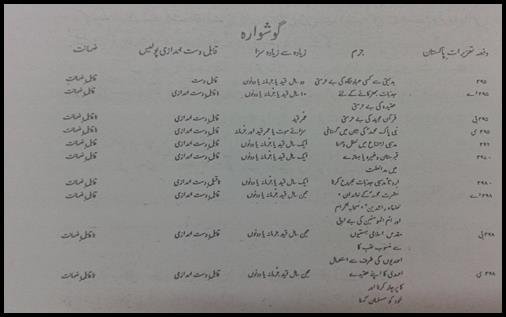
Another reason that can be observed behind the addition of this new article was the influence of different people. Like, in 1986, Nisar Fatima, female member of NA and the member of Jammat-e-Islami, was in Lahore to attend a program in which a woman gave her opinion that Prophet Muhammad (P.B.U.H) was Ummi. This statement and logics given by that woman were disliked by Nisar Fatima and she played her role in passing the law against insulting Prophet Muhammad. (P.B.U.H) Another reason behind the adding of this article was the influence of the political situation of General Zia. To divert the attention of people from him, he passed article 295-C (Jacob & Alexander, 1995, pp.21). As far as punishments of blasphemy are concerned, they are different for different religions and it also depends upon the nature of the case. Following is an image and a table in which punishments are mentioned according to the blasphemy law of Pakistan.
Figure 3
Punishments of Blasphemy (IN URDU)

Table 2. Punishments
for blasphemy in Pakistan (IN ENGLISH)
|
Article |
Description |
Punishments/penalty |
|
298 |
A word, sound, gesture of placing
an object that hurts the religious feelings of a person. |
Imprisonment of one year of fine
or both. |
|
298A |
Derogatory remarks for any holy
personality. |
Imprisonment of three years or
fine or both. |
|
298B |
Misuse of title and e.tc (Ahmadi
blasphemy law) |
Imprisonment of three years and
fine. |
|
298C |
?
Ahmadi calling himself a Muslim. ?
Preaching his faith hurts the
feelings of Muslims. |
Imprisonment of three years and
fine. |
|
295 |
Injuring and harming the religious
places of worship and insulting religion of any class. |
Imprisonment of 2 years or fine or
both. |
|
295A |
Thoughtful and hateful acts
intended to disgrace religious feelings of any class by insulting its
religion and religious beliefs. |
Up to 10 years of Imprisonment or
fine or both. |
|
295B |
Besmirching the Quran. |
Life Imprisonment |
|
295C |
Use of derogatory remarks, spoken,
written, directly or indirectly, etc. defiles the name of Prophet Muhammad |
Death penalty and fine. (case must take place under Muslim
judge in session court) |
Blasphemy laws in Non-Muslim Countries
Denmark, England, Norway)
England
The Church of England is the state religion in the country. History of blasphemy laws starts from the 16th century in England. From the 16th to 19th century, blasphemy was considered an offence. Saying derogatory remarks against God and Jesus Christ was completely an offence in the UK from 16th to 19th century. Punishment of blasphemy included fine, imprisonment and death penalty.
? Taylor’s case was the first case that was reported as a blasphemy case in the UK.
? Another case was registered in 1917 and it was the case of Bowan V secular society. On this case, British government said that, "offences to the gods are dealt with by the gods'': blasphemy is an offence against the (Christian) state, and is prohibited because it tends to subvert (Christian) society; offence to God as such is outside the reach of the law” (Eurotrib.co, 2014).
As the time passed, from 1922 to 1977, no cases of blasphemy were registered in the courts but after 1977, three other cases of blasphemy appeared in 1979, 1990 and 1997. In the late 1990s, debates about protecting the rights of non- Christians also started in the UK because people were of the opinion that these blasphemy laws were only for the protection of Christians. Until 2005, two points of debate were raised. One is either to make these laws applicable for all the religions or to abolish them. Therefore, in 2008, blasphemy laws in the UK were abolished and the prime minister announced that the country will consult with the Church in abolishing the blasphemy laws. So, in May, 2008, blasphemy and apostasy laws were finally abolished from the UK (Crabtree, 2014).
Denmark
The state religion of Denmark is Christianity and the punishable acts in the country mainly include hate speech, child pornography and blasphemy. Denmark is strict about its blasphemy laws and in a recent session of the UN, Denmark says that it will continue its blasphemy laws (Admin, 2015). According to the blasphemy law of the country, “Anybody who publicly mocks or insults any in this country legally existing religious community tenets of faith or worship, will be punished by fine or imprisonment for up to 4 months” (Godhatestheworld.com, 2014).
Norway
In Norway, the state religion of the country is Christianity. Norway is the country where still religious insult is taken as offense and under their penal code of 1902, punishments are given. However, the main blasphemy law of Norway was penal code 142 that was removed in 2009. According to 142, it was said that, anyone "who publicly insults or in an offensive manner shows contempt for any religious creed or for the doctrines or worship of any religious community lawfully existing in Norway” (Council of Europe, 2010). But with the efforts of Heathen Society, this law was abolished in 2009. Talking about the blasphemy case in Norway, a case was registered in 1933 against a writer who gave a speech titled as Christianity-the tenth Plague.”
Blasphemy laws in Secular States
(Turkey, Indonesia and India)
Turkey
Turkey declares itself as a secular state but majority of the population in the country is Muslim. Turkey has blasphemy laws which are explained under the article 216 of their penal code. Under this article, punishments are given for the act of blasphemy, religious insult and hate speech. Punishment includes imprisonment mostly however duration of the punishment depends upon the level of offense. If a person disrespects another's religion or religious beliefs then, punishment of six months to one year is given to that person (Ende, Steinbach, 2010). Turkey took serious action in 2013 towards Facebook and blocked the website for not banning the blasphemous pages. A Turkish pianist was also given imprisonment of 18 months for the crime of blasphemy. He was punished because of his statements on Twitter (Al Monitor, 2013).
Indonesia
Although the majority of the population in Indonesia is Muslim but its official religion includes six major religions which are,
? Islam
? Protestantism
? Catholicism
? Hinduism
? Buddhism
? Confucianism
Article 156(a) of penal code deals with the blasphemy laws. Matter of the fact is that there are six official religions in Indonesia so blasphemy laws are designed by keeping in view the religious feelings and sentiments of all people. Punishment of imprisonment is given for passing hatred remarks towards other religion or hurting anyone’s religious feelings (Crouch 2013). Many cases of blasphemy were registered in the country. Recently in 2012, a man was sent to the jail for saying that ‘God did not exist’ on Facebook. In 2010, a person was sentenced to imprisonment for one year for claiming himself a Prophet.
India
India declares itself as a secular state because people from different religions such as Hinduism, Islam, Sikhism and Christianity are living there. Muslim people are also in the majority but Hinduism is a dominant religion in India. As Hinduism believes in Polytheism and monotheism, there are not as such blasphemies laws present in India but the few present laws can be named under hate speech. However, article 295-A of Indian penal code is considered as blasphemy law in India. This law was passed on the demand of Muslims of India. As India was the colony of British Empire and British colonizers took care of all religions in the sub-continent. Therefore, they approved article 295-A which states that,
“Whoever, with deliberate and malicious intention of outraging the religious feelings of any class of [citizens of India], [by words, either spoken or written, or by signs or by visible representations or otherwise,] insults or attempts to insult the religion or the religious beliefs of that class, shall be punished with imprisonment or either description for a term which may extend to [three years], or with fine, or with both” (Neelamalar, 2009).
Section 295 also describes the punishments for destroying the worshiping places in the country. Punishments may include fine, imprisonment or both. Many blasphemy cases are reported in India but all happened 50 years before. For example, a case was registered against a Tamil reformer in 1953 for smashing the idol of Ganesh (Patel, 2012).
Discussion
After studying the blasphemy laws in different countries of the world, it can be said that, blasphemy laws are present in most of the Muslim countries. However, punishments and their procedure are different in different regions. On the other hand, it can be said that in Non-Muslim countries, blasphemy laws are smashing with the passage of time. But, laws for hate speech are still in practice. Coming back to the Muslim countries, it can be said that punishments for blasphemy differs from one school of thought to the other and procedure also differs from one country to the other. It can be observed from the blasphemy cases of Pakistan that blasphemy laws are more misusing here. In an interview with a Shia-Islam’s representative, a question is asked regarding the procedure of giving punishments to the convicted person of blasphemy. In an answer to this question, he shares that according to Islam, punishment should be given after the Court hearings and judge must first check that there should not be any personal grudge among eye witness and convicted person. He further shares that, even then, it is necessary to first give some lighter punishments such as strokes and also invite him/her towards religion. If he or she does not take the words back even after the invitation or light punishments, then that person should give death penalty. So, it can be summarized that punishments against blasphemy should be given but these punishments must follow some procedure. Moreover, it is the duty of the state to take care of the religious beliefs of its citizen. It does not matter that what is the official religion of the state. The thing, which matters is that does the people from different religious beliefs are living a peaceful live in a country or not. It is the responsibility of the state to provide protection to its every citizen.
Conclusion
To conclude the entire discussion, it can be said that implementation of blasphemy laws is very necessary all over the world. In the literature review, it is studied that blasphemy or apostasy laws are present in three main divine religious; Judaism, Christianity and Islam. Holy Books explain that passing derogatory remarks towards God, sacred things and Prophets is not tolerable and punishments must be given for these offenses. But, it is also suggested that before giving punishments, it should be checked that the person is convicted of that offense or not. By using the descriptive research methodology, researchers studied the blasphemy laws and cases in five Muslims countries, three non-Muslim countries and three secular countries. It can be concluded from these in-depth studies that, blasphemy laws are present in almost all Muslim countries and in some Non-Muslim countries. Blasphemy laws are also practicing in the secular states however in both secular and Non-Muslim countries, these laws are mostly known by the name of ‘laws for hate speech’.
Limitations
Limitations of the study are as follows.
• Research could not study the blasphemy laws of the entire world.
• Due to the issue of time constraint, researchers were not able to contact maximum religious scholars and lawyers.
• Because of the spiral of silence issue on the topic of blasphemy, people in Pakistan do not share their views openly.
Future Research
In future, researchers may study different perspectives of blasphemy. A major perspective that is missing on the issue of blasphemy is the feminist perspective. In future, study can be conducted on the feminist perspective of blasphemy and opinions of female Muslim scholars can be gathered on this issue.
References
- Admin, I. (2015). International Humanist and Ethical Union | Denmark announces it will keep its blasphemy law. Iheu.org.
- Ahmad, N. (1998). Blasphemy in the Light of the Qur'an. Muslimcanada.org.
- Al-Monitor. (2013). Blasphemy in Turkey - And the Fazil Say Affair - Al-Monitor: the Pulse of the Middle East.
- Biblehub.com,. (2019). Topical Bible: Blasphemy.
- Council of Europe.,. (2010). Blasphemy, Insult and Hatred - Finding Answers in a Democratic Society (Science and Technique of Democracy No. 47). Council of Europe.
- Crabtree, V. (2012). Blasphemy and Censorship: In Christianity and Islam. www.vexen.co.uk.
- Crabtree, V. (2014). Blasphemy and Censorship: In Christianity and Islam.
- Crouch, M. (2013). Law and religion in Indonesia. Routledge,.
- David, J. (2015). After Paris and Copenhagen, can free speech learn to live with religion?. cnbc.
- Ende, W., & Steinbach, U. (2010). Islam in the world today. Ithaca, N.Y.: Cornell University Press
- Eurotrib.com,. (2014). European Tribune - Comments - On Minority Rights and on Beliefs.
- Former Muslims United,. (2010). Al-Azhar Fatwa.
- Gilani, S. (2010). Punishment for Blasphemy in the Light of Religious Scriptures. awgilani.
- Godhatestheworld.com,. (2014). Denmark's Evil Government.
- Gundy, Z. (2015). Timeline of Egyptian reactions to blasphemy and insults to Islam. englishahram.
- Iranhrdc.org,. (2012). Iran Human Rights Documentation Center - Understanding the Rushdie Affair: Blasphemy and Extrajudicial Killing in Shi'a Islam (May 2012).
- Islamicboard.com,. (2006). Blasphemy Punishments in the Bible.
- Jacob, P., & Alexander, A. (1995). Section 295-C Pakistan Penal Code (History, effects and cases under blasphemy laws in Pakistan). Faisalabad: Komi Commission barai amaan o insaf Pakistan.
- Jacobs, R. (2006). Blasphemy in Judaism. Myjewishlearning.com.
- Jones, P. (1980). Blasphemy, Offensiveness and Law. British Journal of Political Science, 10(2), 129-148.
- Keyes, L. (1983). Third world mission agency directory (p. 40). [Pasadena, CA]: [William Carey Library].
- Merriam-webster.com,. (2019). Definition of Blasphemy.
- Modood, T. (1993). Muslim views on religious identity and racial equality. Journal Of Ethnic And Migration Studies, 19(3), 513- 519. doi:10.1080/1369183x.1993.9976381
- Neelamalar, M. (2009). MEDIA LAW AND ETHICS. PHI Learning Pvt. Ltd.
- Nina, S. (2009). Insulting Islam
- Patel, A. (2012). Blasphemy law in India - The Express Tribune. The Express Tribune.
- Patel, A. (2012). Pakistan's blasphemy law. The Express Tribune.
- Stefani, P. (2014). Freedom and Democracy: What does ‘blasphemy' mean in Judaism? -Piero Stefani, University of Ferrara | Reset Dialogues on Civilizations. Resetdoc.org.
- Sunnah.com,. (2019). Ka'b b. Ashraf (page 1).
- THE IMPACT OF Blasphemy Laws on Human Rights. (2011) (1st ed.).
- THEODOROU, A. (2014). Which countries still outlaw apostasy and blasphemy?. pew research centre.
- Tiburcio, C. (2001). The human rights of aliens under international and comparative law. The Hague: M. Nijhoff Publishers.
- Vesterinen, A. (2013). Malaysia | New Humanist. Newhumanist.org.uk.
Cite this article
-
APA : Zehra, F., Sheraz, H. M., & Suleman, M. (2021). A Legal Perspective on Blasphemy within Muslim, Secular and Non-Muslim States. Global Digital & Print Media Review, IV(IV), 10-23. https://doi.org/10.31703/gdpmr.2021(IV-IV).02
-
CHICAGO : Zehra, Fatima, Hafiz M. Sheraz, and Muhammad Suleman. 2021. "A Legal Perspective on Blasphemy within Muslim, Secular and Non-Muslim States." Global Digital & Print Media Review, IV (IV): 10-23 doi: 10.31703/gdpmr.2021(IV-IV).02
-
HARVARD : ZEHRA, F., SHERAZ, H. M. & SULEMAN, M. 2021. A Legal Perspective on Blasphemy within Muslim, Secular and Non-Muslim States. Global Digital & Print Media Review, IV, 10-23.
-
MHRA : Zehra, Fatima, Hafiz M. Sheraz, and Muhammad Suleman. 2021. "A Legal Perspective on Blasphemy within Muslim, Secular and Non-Muslim States." Global Digital & Print Media Review, IV: 10-23
-
MLA : Zehra, Fatima, Hafiz M. Sheraz, and Muhammad Suleman. "A Legal Perspective on Blasphemy within Muslim, Secular and Non-Muslim States." Global Digital & Print Media Review, IV.IV (2021): 10-23 Print.
-
OXFORD : Zehra, Fatima, Sheraz, Hafiz M., and Suleman, Muhammad (2021), "A Legal Perspective on Blasphemy within Muslim, Secular and Non-Muslim States", Global Digital & Print Media Review, IV (IV), 10-23
-
TURABIAN : Zehra, Fatima, Hafiz M. Sheraz, and Muhammad Suleman. "A Legal Perspective on Blasphemy within Muslim, Secular and Non-Muslim States." Global Digital & Print Media Review IV, no. IV (2021): 10-23. https://doi.org/10.31703/gdpmr.2021(IV-IV).02